 |
From Seamanship Notes

|
SS |
Somewhere in October 1971 I was invited by a friend to join
him to go on board a ship berthed in Colombo harbor. I was delighted at the
invitation. But I explained to him my problem. He said that he would obtain
permission from my mother. He came with his brother, who happened to be the
third officer on that ship. My mother then
allowed me to go on board the ship with them. It was great. As the Third
Officer, he was living in luxury. We were invited to dinner, but we declined.
Therefore, we were served with a hot cup of soup brought in by a steward. I
went around the ship, and it was out of this world.
One day when my mother was in a good mood I explained to her
about the ship that I visited and
One day when my father was at home, I just mentioned my idea
to him. His immediate response was "Don’t talk nonsense". As he was a
person of few words, it took another month or so to find out why he said that.
I invited home the friend who was an officer on the ship which I visited. At
that time, my father was there. He obliged. He came and had lunch with us. It
was extremely difficult to convince my parents. They went on saying that I
being the eldest in the family, they just cannot even think of sending me to
sea, considering the dangers and other activities involved in seafaring.
|
|
It was around
this time I was informed by one of my uncles that a company in Sri Lanka based in
Colombo will be calling applications for Officer Cadets in the Merchant Navy. Few
days later, it was advertised in the papers. After a long deliberation, my
father agreed to help me with the application. Thereafter I submitted my
application.
However, there was a huge doubt about whether or not I will be called for the interview as I didn’t possess the required qualifications. I prayed to God and also attended novenas of Our Lady of the Miraculous Medal, and other church services, praying and asking for God’s help for me to get this job.
In March of that year, I received a letter from the company calling me for the interview. I did attend the interview, and I was interviewed by a senior captain in the merchant marine. He asked me if had a recent Vision Test report. When I said, No. He wanted me to get one and come back in two days. When I returned with the Vision Test report the captain checked it and was satisfied.
Then he asked for the educational qualifications. I certainly did not have what he was looking for. Then he handed back my folder containing all my certificates and told me to get the certificate he wanted and to return on the following day. There was no way of getting the certificate because I did not have it.
That day during the night I prayed and cried to our Father in Heaven asking for his help.
It took a very long time for me realize it was a Miracle, and a direct act of God.
Reminiscing about the old days:
My brother and I travelled to school by
bus. On this particular day, I had forgotten to take with me the season tickets or the monthly pass we had to
travel by bus to school. I realized this when I was ready to leave school that
afternoon. We traveled to school at the same time each day, therefore the bus conductor
knew us very well. So, he asked for the monthly pass usually for inspection
only on very first day of teach month. As a result of this we traveled by bus and
got to school. However, I didn’t have any money with me to pay the return bus fare
due to the absence of the monthly pass.
I did not want to ask any help from anyone,
and made up my mind, and said to myself, "No, we are walking back
home".
At that time, I must have been about eleven
years, and my brother was four years younger to me. The distance from the
school to our home was about four miles. We walked back home and arrived home only
about 30 minutes later than usual time. It was not noticed by my mother and
therefore no questions were asked. We were very tired, but everything was fine
but not for long. When my father returned from office, he came straight to me
and asked me "how did both of you get back home from school today?" I
replied "by bus as usual" he
got so angry and caned me very severely. He certainly had known how we got back
home!
I have never seen him so angry before and I
did not see it till he died. The best part here was comparing the time taken to
get home by bus and our walking back the difference was only about 30 minutes.
That was a memorable day in my life. Although I was severely punished by my
father for lying to him and for making my little brother walk all that
distance, I was proud that in a situation like that I did not depend on anyone
but made it my way.
Copied from an article in the Guardian to YouTube.
Details are still emerging about the disaster that happened in the early morning of March 26, 2024, when the Dali, a large cargo ship on its way out of the port of Baltimore, hit a major bridge and caused it to collapse.
The Conversation’s senior politics and democracy editor, Naomi Schalit, spoke with Captain Allan Post, a veteran ship’s officer, about the role a ship pilot plays in bringing a large ship in and out of a harbor. Post, who now directs Marine Education Support and Safety Operations at Texas A&M University at Galveston and is also deputy superintendent of the Texas A&M Maritime Academy, said the disaster was “absolutely” every crew member’s nightmare.
What was your first thought when you heard about the accident?
Post: My first thought was, thank God it happened at night, because of the low amount of traffic on the bridge. If that had happened during the daytime, casualties would be in the thousands. My heart aches for those lives lost.
Post: Ship pilots are brought on board in what are considered restricted maneuverability or navigation areas. They are local experts who are usually certified by the state or federal government to provide advice to the master of the vessel as to how to control the vessel, safely and adequately, through the pilotage waters, which in this case would be down the river from the Port of Baltimore.
Pilots are well practiced in close-quarters maneuvering, especially with tugboats and docking the vessel alongside the assigned berth.
But a pilot doesn’t come aboard the ship and take control of it, do they?
Post: They are just advisers to the captain, who is known as the “master.” The master still has full responsibility for the safe navigation of the vessel. So the pilot will meet the ship out at sea or at the dock if it’s in port and leaving to go to sea. They proceed up to the bridge. Usually they exchange greetings, and usually a little bit of ship’s swag is given, either a hat or something else, or at least a cup of coffee.
They then set up their gear. With the electronics that we now have, they plug into the ship’s electronic chart data information system. And then they conduct the pilot exchange with the master of the vessel, where the master of the vessel describes where they are going, what the characteristics of the ship are, who’s on the bridge, what their first language is and the air draft of the vessel, which refers to how high out of the water the vessel is, so that you know whether you can take the ship under a bridge safely.
Once that’s completed, the pilot then starts instructing the officer of the watch or the captain – those are usually the same person – in how to get to where they need to be to dock the ship, or undock the ship and bring it to sea. This instructing is done during complex maneuvers, not all the time. The pilot can also say he’s not going to do it, and can shut down their operations if conditions are unsafe or if they feel that the vessel is not in condition to be able to transit safely. That happens a lot, especially in fog.
The ship pilot also interacts with the Coast Guard Vessel Traffic Service and other ships in the area, and coordinates with the tugboats and line handlers to be able to safely maneuver the vessel close to the pier or when a ship is leaving the berth.
Can you describe the training of a ship pilot?
Post: Most of them start out at a maritime academy and have to spend many years at sea in command or as a bridge watch-stander on a vessel. From there, they start into the pilot apprentice program that each one of the pilot associations has, and those programs last years. What they do in those programs is use simulators and real, actual hands-on training, so that they can see how the different ships maneuver, how different places along the route have different currents and tides, and how the channels affect the ships.
It’s not something that you can go to a sea school for three weeks to learn and then come out and be a pilot. It’s many years long. They’re really the surgeons of the sea.
So when a ship’s pilot shows up, they’re going to be someone with a minimum of how many years training before they even get onto your ship?
Post: Many have 10-plus years before they are allowed to work on their own.
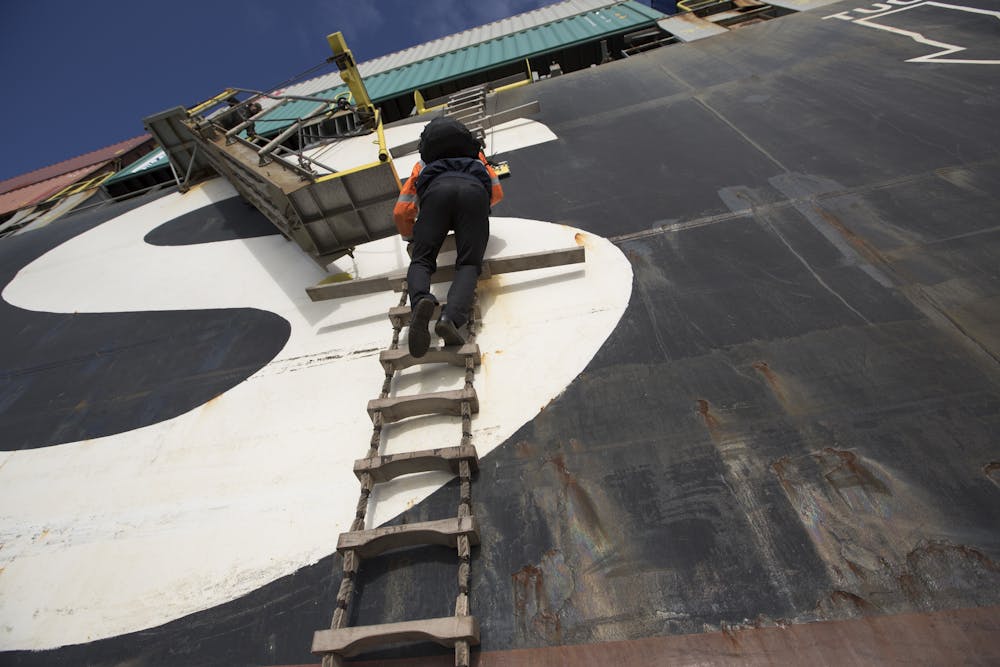
They have to be specialists in the place where they work, don’t they?
Post: Most of them are ship’s officers licensed by the U.S. Coast Guard, and they’re licensed for unlimited tonnage vessels. But that’s not the end of training. From there, they are hired into the pilot apprentice programs for the area in which they’re going to gain their pilot endorsement or credentials. One pilot may not be credentialed in another area. They spend many years under the guidance of senior pilots who teach them basically everything that they need to know about the local waterways, about the navigation, current tides, where all the berths are. They become absolute experts in how to do this. And then, when most of them end up taking the pilotage exam, they have to draw the charts that they would be using in the pilotage waters – from memory.
Are there legal requirements for ship pilots to be present both going out of and coming in these restricted areas?
Post: Yes, there are – state law, federal law or both.
This is an almost 1,000-foot-long vessel. Is that big, small or medium?
Post: That’s about standard size these days. Ship sizes have absolutely grown monstrous over the years. But 1,000 feet is just about normal.
Has ship piloting been around for a long time?
Post: It’s been around for almost as long as man has been using the sea for commerce. In the early years of sea travel, and even now, a captain is not going to know every port, so he would bring on a person with local knowledge. It started out a lot of times as local fishermen. In the U.S., the Sandy Hook Pilots Association has been piloting ships in and out of New York Harbor for about 300 years.
Was what happened in Baltimore every captain, pilot and crew’s nightmare?
Post: Absolutely. My initial assumption is that I think it’s going to come down to an electrical fault on the ship that was just terrible timing.
I looked at my Blog after a very long time.
I am making changes to the type of posts: from Merchant Marine and shipping stuff to a more general ones.
Thank you to all of you who are following my blog, and my apologies for being out of the scene for a very long time.
Lets start:
Wishing my followers a Very Happy and a Prosperous 2023. (Better later than never!!)
Authorities in Sri Lanka have reportedly arrested the captain of the stricken X-Press Pearl which caught fire and sank off the coast of Colombo after a chemical leak last month, the Straits Times reported Monday.
The arrest comes after investigations into the incident and statements from the captain and others on board, including the chief engineer.
The Singapore-registered X-Press Pearl, delivered only in February, reported smoke in a cargo hold after it arrived at a Colombo anchorage on May 20 carrying 1486 containers, including 81 Dangerous Goods Containers and 25 tonnes of Nitric Acid.
In the aftermath of the fire, it was revealed that prior to the ship’s arrival in Sri Lankan waters, one of the containers with nitric acid was discovered to be leaking. While the X-Press Pearl called Hamad Port in Qatar and Hazira Port in India for discharge and loading operations, they were unable to offload the leaking container as the ports lacked the specialized facilities and expertise to deal with the situation.
Despite fire-fighting efforts, the fire grew to engulf the entire vessel and the X-Press Pearl eventually sank as salvors were attempting to tow it to deeper waters. The ship’s stern is now resting on the bottom at depth of about 21 meters while the forward section remains partially afloat.
Although the ship’s operator reports that no noticeable fuel oil has spilled from the vessel, chemicals and small plastic pellets have been released into the environment and spread to nearby beaches and fishing grounds.
“A grey sheen continues to be observed emanating from the vessel. Discolouration of the sea has been apparent since the vessel’s stern became submerged, and the remnants of the cargo in the 1486 containers that were onboard were exposed to water,” an update from X-Press Feeders dated June 12 said.
The ship is reported to be carrying 297 tonnes of Heavy Fuel Oil and 51 tonnes of Marine Fuel Oil.
“The salvors will remain on scene to deal with any possible debris supported by the Sri Lankan Navy and the Indian Coast Guard, who have oil spill response capabilities on standby,” the update said.
I joined a Marine Survey Company in Colombo which was owned by a Senior Master Marine and Marine Surveyor, and started work as a trainee marine surveyor. I enjoyed the work very much. About six months later, I was made permanent and started to work as a marine surveyor. It was not an 8-5 job and as such, we had to be prepared to work anytime, any day.


