Showing posts with label Mutiny on The Bounty. Show all posts

After the Mutiny on the Bounty: Fletcher Christian


The American seal-hunting ship Topaz visited Pitcairn in 1808 and found only one mutineer, John Adams (who had used the alias Alexander Smith while on Bounty), still alive along with nine Tahitian women. The mutineers who had perished had, however, already had children with their Tahitian wives. Most of these children were still living.

Adams and Maimiti claimed Christian had been murdered during the conflict between the Tahitian men and the mutineers. According to an account by a Pitcairnian woman named Jenny who left the island in 1817, Christian was shot while working by a pond next to the home of his pregnant wife. Along with Christian, four other mutineers and all six of the Tahitian men who had come to the island were killed in the conflict. One of the four surviving mutineers fell off a cliff while intoxicated and was killed. Quintal was later killed by the remaining two mutineers, Adams and Ned Young, after he attacked them. Young became the new leader of Pitcairn.


Christian's consort, Isabella


This intimate portrait seeks to be of a vision only a lover holds in his mind. There is little evidence Fletcher Christian was ever deeply in love with anyone but himself - but then again that is supposedly a pre-requisite for the real thing. The cloth that drapes the girl’s glistening coconut scented body is woven with European colours. A gift from Christian.
 
The islanders kept  a detail log which included the
By John Shillibeer, c. 1814Christianson
true fates of the Englishmen and the Tahitians. Disputes over women, authority and slavery had torn the group apart, with murders having taken place on both sides. Fletcher Christian had been killed by two of the Tahitians on the island's bloodiest day in 1793 on which four of the Englishmen died. Christian was survived by his Tahitian wife Maimiti and three children: Thursday, Charles, and Mary Ann. Thursday, the oldest, was not quite three years old when his father was killed, so Adams (and one other who had died in the interim) were the only Englishmen any of them ever really knew. Maimiti witnessed her husband's death and later recounted it in great detail. This was the true history of Pitcairn Island's colonists according to all of them who were ever asked.

Pitcairn Island

Photograph by Luis Marden


Bounty was run ashore and burned in the shallow water of this rocky inlet. Christian and his followers destroyed the ship in 1790 to hide from searchers. The grid of logs and timbers (at right) helps oarsmen haul their craft up to the thatched boathouses beyond reach of the smashing surf.


Photograph by Andrew Christian


Fletcher Christian's cave is where the lead mutineer is said to have watched for approaching ships and/or hid from his ruthless fellow settlers when necessary.  


House of Fletcher Christian, Pitcairn Island


The Mutiny on the Bounty: Mutineers in Tahiti


Mutineers Landing at Pitcairn Island
Painting by Richard Beechey, c.1825


After the mutiny, Christian and his sailors returned to Tahiti, where sixteen of the twenty-five men decided to remain for good. Christian, along with eight others, their women, and a handful of Tahitian men then scoured the South Pacific for a safe haven, eventually settling on Pitcairn on January 23, 1790.

An isolated volcanic island 1,350 miles southeast of Tahiti, it was named after British midshipman Robert Pitcairn, who first sighted the island on July 2, 1767. Its location had been incorrectly charted by the explorer Carteret, who missed the mark by 200 miles, and was therefore the ideal refuge for the mutineers. Although a British ship spent three months searching for them, the mutineers eluded detection. Those who had remained on Tahiti were not so lucky. They were swiftly captured and brought to trial in England, where seven were exonerated and three were hanged.


Mutiny on the Bounty: The Mutiny

Mutiny on HMS Bounty

From the 'Bounty Chronicles' (by John Hagan), 28 original oil paintings depicting characters and scenes of the HMAV Bounty
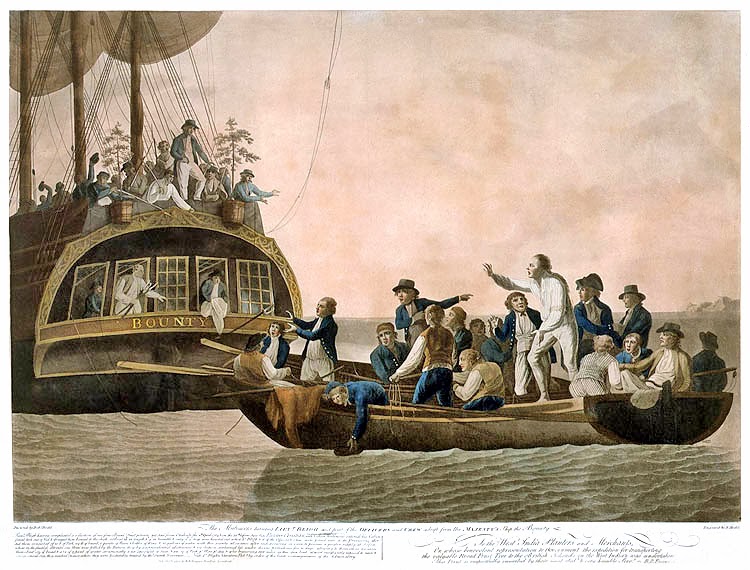
The mutiny occurred on 28 April 1789, some 23 days out and 1,300 miles west of Tahiti.

Fletcher Christian had that morning contemplated making a raft and deserting the ship by paddling around 30 nautical miles (56 km; 35 mi) to the nearby island of Tofua. Instead he and several of his followers entered Bligh's cabin, which he always left unlocked. They awakened Bligh and pushed him on deck wearing only his nightshirt, where he was guarded by Christian holding a bayonet. When Bligh entreated Christian to be reasonable, Christian would only reply: "I am in hell, I am in hell!" Despite strong words and threats on both sides, the ship was taken bloodlessly and apparently without struggle by any of the loyalists except Bligh himself. Of the 42 men on board aside from Bligh and Christian, 18 joined the mutiny, two were passive, and 22 remained loyal to Bligh.

The mutineers ordered Bligh, the ship's master, two midshipmen, the surgeon's mate (Ledward), and the ship's clerk into Bounty's launch. Several more men voluntarily joined Bligh rather than remaining aboard, as they knew that those who remained on board would be considered de jure mutineers under the Articles of War.


 Several facts that bear on the mutiny are generally agreed by all authorities:
  •     Captain Bligh was a harsh disciplinarian, a man of flaring temper, seemingly mindless of the cut of his words on others. His civility, though, returned as quickly as his temper flared.
  •     Once at sea on April 4, 1789, after gathering the breadfruit plants on Tahiti, most of the ship's crew sorely missed the feminine companionship they had enjoyed at the hands of the Tahitian women, and they sought ways they could influence the Bounty's return to the island.
  •     Royal Navy rules of the time called for blind obedience of a ship captain's orders. As the Bounty left Tahiti both officers and men began to ignore or disobey their captain's orders.

In all, 18 of the loyal crew were in the launch with Bligh; 4 other loyalists were forced to stay with the 18 mutineers and 2 passive crew. Bligh and his crew headed for Tofua (in a bay that they subsequently called "Murderers' Cove") to augment their meager provisions. The only casualty during this voyage was a crewman, John Norton, who was stoned to death by some natives of Tofua.

Mutiny on the Bounty: Bounty arrives Tahitie


This large canvas attempts an allegory with the sunrise the beginning in the symbolic sense and a beginning of a visit in the real sense; it is also the beginning of the end as Bligh was to discover.

The format is deliberately long and narrow to show the canoes coming from distant shores to welcome the strange visitors. Soon the natives will be swarming the decks of the Bounty.


Celebration Feast on Tahitie After a few days the crew of the Bounty are invited ashore for a feast, the usual dancing and good times. 


Read more


Mutiny on the Bounty: Outward voyage and arrival


One particular historic attempt to round the Horn, that of HMS Bounty in 1788, has been immortalized in history due to the subsequent Mutiny on the Bounty.  The Bounty made only 85 miles of headway in 31 days of east-to-west sailing, before giving up by reversing course and going around Africa.

On 23 December 1787, Bounty sailed from Spithead for Tahiti with a complement of 46 officers and men. For a full month, she attempted to round Cape Horn, but adverse weather blocked her. Bligh ordered her turned about, and proceeded east, rounding the Cape of Good Hope and crossing the width of the Indian Ocean. During the outward voyage, Bligh demoted the ship's sailing master, John Fryer, replacing him with Fletcher Christian. This act seriously damaged the relationship between Bligh and Fryer, and Fryer would later claim Bligh's act was entirely personal. Bounty reached Tahiti on 26 October 1788, after ten months at sea.

Bligh and his crew spent five months in Tahiti, then known as "Otaheite," collecting and preparing a total of 1,015 breadfruit plants; the five-month layover was unplanned, required to allow the plants to reach the point of development where they could be safely transported by ship. Bligh allowed the crew to live ashore and care for the potted breadfruit plants, and they became socialized to the customs and culture of the Tahitians. Many of the seamen and some of the "young gentlemen" had themselves tattooed in native fashion. Master's Mate and Acting Lieutenant Fletcher Christian married Maimiti, a Tahitian woman. Other warrant officers and seamen of the Bounty were also said to have formed "connections" with native women.

Bligh was not surprised by his crew's reaction to the Tahitians. He recorded his analysis:

    The women are handsome ... and have sufficient delicacy to make them admired and beloved – The chiefs have taken such a liking to our people that they have rather encouraged their stay among them than otherwise, and even made promises of large possessions. Under these and many other attendant circumstances equally desirable it is therefore now not to be wondered at ... that a set of sailors led by officers and void of connections ... should be governed by such powerful inducement ... to fix themselves in the midst of plenty in the finest island in the world where they need not labour, and where the allurements of dissipation are more than equal to anything that can be conceived.

 
    — A Narrative of the Mutiny, etc., by Lieut. W. Bligh, 1790, p. 9.


Mutiny on The Bounty


The ill-fated voyage of the Bounty would never have happened had it not been for the discovery in 1769 of a botanical curiosity, given the name "breadfruit," on the island of Tahiti.  

On board the Endeavor, captained by the celebrated James Cook, as it sailed into Tahiti was some of England's best scientific talent, including botanist Joseph Banks.  After the American colonies achieved independence, and the reliable supply of fish they had been exporting to England became unavailable, Banks (named in 1778 as the president of the Royal Society) concluded breadfruit might fill the sudden gap in the diet of English slaves working the sugar plantations of Jamaica and the Lesser Antilles.  Support built for an expedition to retrieve and transplant breadfruit, thanks to Banks constantly pushing the idea, and in 1787 Banks successfully petitioned the king to sponsor the effort.  A vessel was obtained and a commander, William Bligh, selected.  The voyage, however, did not rank high in the Admiralty's priorities--the ship was small, and Bligh was denied the status "master and commander" and the other commissioned officers and security force usually given to the captain of a voyage of such length.

Mutiny on The Bounty: Breadfruit

Joseph Banks (1743-1820)
Sir Joseph Banks and others saw the value of breadfruit as a highly productive food in 1769, when stationed in Tahiti as part of the Endeavour expedition commanded by Captain James Cook. The late-18th-century quest for cheap, high-energy food sources for British slaves prompted colonial administrators and plantation owners to call for the introduction of this plant to the Caribbean. As President of The Royal Society, Banks provided a cash bounty and gold medal for success in this endeavor, and successfully lobbied his friends in government and the Admiralty for a British Naval expedition. 

In 1787, William Bligh was appointed Captain of the HMS Bounty, and was instructed to proceed to the South Pacific for this task. Banks appointed a gardener for the expedition and gave detailed instructions on how the plants were to be maintained.


In June 1787, Bounty was refitted at Deptford. The great captain's cabin was converted to house the potted breadfruit plants, and glazed windows were fitted to the upper deck, while a lead lining was installed on the floor to catch and re-use run-off water used to feed the plants. Bligh was quartered in a small cramped cabin next to crew and officers

William Bligh
On December 23, 1787, after weeks of delay, the Bounty sailed from Spithead, England, bound for Tahiti by way of Cape Horn.  Arriving at the tip of South America in late March, the Bounty encountered day after day of mountainous waves that finally forced Bligh to order a ten thousand mile detour around Africa's Cape of Good Hope.  The Bounty reached Cape Town on May 24, where it remained for thirty-eight days as it was completely overhauled and resupplied.  Bligh wrote, "Perhaps a Voyage of five Months which I have now performed without touching at any one place but at Tenarif [Canary Islands], has never been accomplished with so few accidents, and such health among Seamen in a like continuance of bad weather." During the difficult months at sea and the layover on the Cape, Bligh and Christian remained on good terms.  In Cape Town, in fact, Bligh loaned money to Christian, a not insignificant act of friendship from someone who himself had to watch every penny.  

During the outward voyage, Bligh demoted the ship's sailing master, John Fryer, replacing him with Fletcher Christian. This act seriously damaged the relationship between Bligh and Fryer, and Fryer would later claim Bligh's act was entirely personal. Bounty reached Tahiti on 26 October 1788, after ten months at sea.


(Source: Wikipeida ; http://law2.umkc.edu/faculty/projects/ftrials/Bounty/bountyaccount.html)