Showing posts with label Sigiriya. Show all posts

Sigiriya Cobra Hood Cave

This is known by the name Cobra Head cave due to the natural shape of the rock itself.


The early Brahmi inscriptions indicate that this had been donated by a chieftain 'Naguliya' to the Sangha.


This cave had been used as a dwelling place for the Buddhist monks or the Sangha between 3rd and the 1st Centuries BC.


A rock cave with a dwelling place- inside construction Sigiriya


A rock cave with a dwelling place Sigiriya


The painting done on the cave ceiling belongs to the 6-7 th Centuries AD.

The Gardens of Sigiriya, Lion Rock

View of one of the pools in the garden complex

The water gardens can be seen in the central section of the western precinct. Three principal gardens are found here. The first garden consists of a plot surrounded by water. It is connected to the main precinct using four causeways, with gateways placed at the head of each causeway. This garden is built according to an ancient garden form known as char bagh, and is one of the oldest surviving models of this form.

The second contains two long, deep pools set on either side of the path. Two shallow, serpentine streams lead to these pools. Fountains made of circular limestone plates are placed here. Underground water conduits supply water to these fountains which are still functional, especially during the rainy season. Two large islands are located on either side of the second water garden. Summer palaces are built on the flattened surfaces of these islands. Two more islands are located farther to the north and the south. These islands are built in a manner similar to the island in the first water garden.
The gardens of Sigiriya, as seen from the summit of the Sigiriya rock

The third garden is situated on a higher level than the other two. It contains a large, octagonal pool with a raised podium on its northeast corner. The large brick and stone wall of the citadel is on the eastern edge of this garden.

The water gardens are built symmetrically on an east-west axis. They are connected with the outer moat on the west and the large artificial lake to the south of the Sigiriya rock. All the pools are also interlinked using an underground conduit network fed by the lake, and connected to the moats. A miniature water garden is located to the west of the first water garden, consisting of several small pools and watercourses. This recently discovered smaller garden appears to have been built after the Kashyapan period, possibly between the 10th and 13th centuries.


The boulder gardens

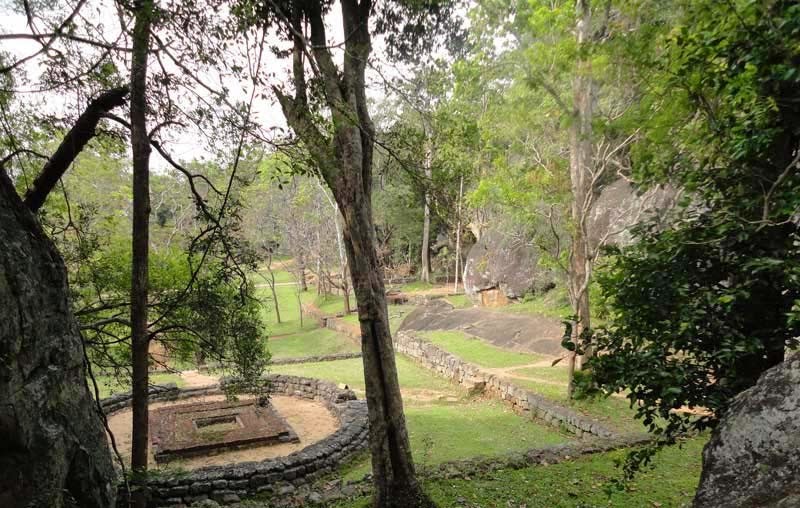
The boulder gardens consist of several large boulders linked by winding pathways. The gardens extend from the northern slopes to the southern slopes of the hills at the foot of Sigiris rock. Most of these boulders had a building or pavilion upon them; there are cuttings that were used as footings for brick walls and beams.it is a vital component of the spite.


The Sigiriya Rock seen from the Fountain Gardens


The terraced gardens

The terraced gardens are formed from the natural hill at the base of the Sigiriya rock. A series of terraces rises from the pathways of the boulder garden to the staircases on the rock. These have been created by the construction of brick walls, and are located in a roughly concentric plan around the rock. The path through the terraced gardens is formed by a limestone staircase. From this staircase, there is a covered path on the side of the rock, leading to the uppermost terrace where the lion staircase is situated.


View of the moat

Sigiriya, Lion Rock: The Mirror Wall

Originally this wall was so well polished that the king could see himself whilst he walked alongside it. Made of a kind of porcelain, the wall is now partially covered with verses scribbled by visitors to the rock. Well preserved, the mirror wall has verses dating from the 8th century. People of all types wrote on the wall, on varying subjects such as love, irony, and experiences of all sorts. Further writing on the mirror wall now has been banned for the protection of old writings of the wall.


Dr Senerat Paranavitana, an eminent Sri Lankan archaeologist, deciphered 685 verses written in the 8th, 9th and 10th centuries CE on the mirror wall.

One such poem in Sinhala is:

    "බුදල්මි. සියොවැ ආමි. සිගිරි බැලිමි. බැලු බැලු බොහො දනා ගී ලීලුයෙන් නොලීමි."

The rough translation is: "I am Budal [the writer's name]. (I) Came alone to see Sigiriya. Since all the others wrote poems, I did not!" He has left an important record that Sigiriya was visited by people beginning a very long time ago.


Sigiriya Lion Rock

Sigiriya consists of an ancient castle built by King Kashyapa during the 5th century. The Sigiriya site has the remains of an upper palace sited on the flat top of the rock, a mid-level terrace that includes the Lion Gate and the mirror wall with its frescoes, the lower palace that clings to the slopes below the rock, and the moats, walls, and gardens that extend for some hundreds of metres out from the base of the rock.

The site is both a palace and a fortress. The upper palace on the top of the rock includes cisterns cut into the rock that still retain water. The moats and walls that surround the lower palace are still exquisitely beautiful.


Rock shelters at the foot of the Sigiriya rock


Sigiriya - the path climbing up the rock fortress


Sigiriya - the stone seat of King Kasyapa

Sigiriya, Lion Rock


Lion Gate
Sigiriya is located in the central Matale District of the Central Province, Sri Lanka in an area dominated by a massive column of rock nearly 200 meters high.

According to the ancient Sri Lankan chronicle the Culavamsa the site was selected by King Kasyapa (477– 495 CE) for his new capital. He built his palace on the top of this rock and decorated its sides with colourful frescoes. 

On a small plateau about halfway up the side of this rock he built a gateway in the form of an enormous lion. 


The name of this place is derived from this structure —Sīhāgiri, the Lion Rock. The capital and the royal palace were abandoned after the king's death. It was used as a Buddhist monastery until the 14th century.

Sigiriya today is a UNESCO listed World Heritage Site. It is one of the best preserved examples of ancient urban planning. It is the most visited historic site in Sri Lanka.